Kenya-headquartered · Serving Africa & Beyond
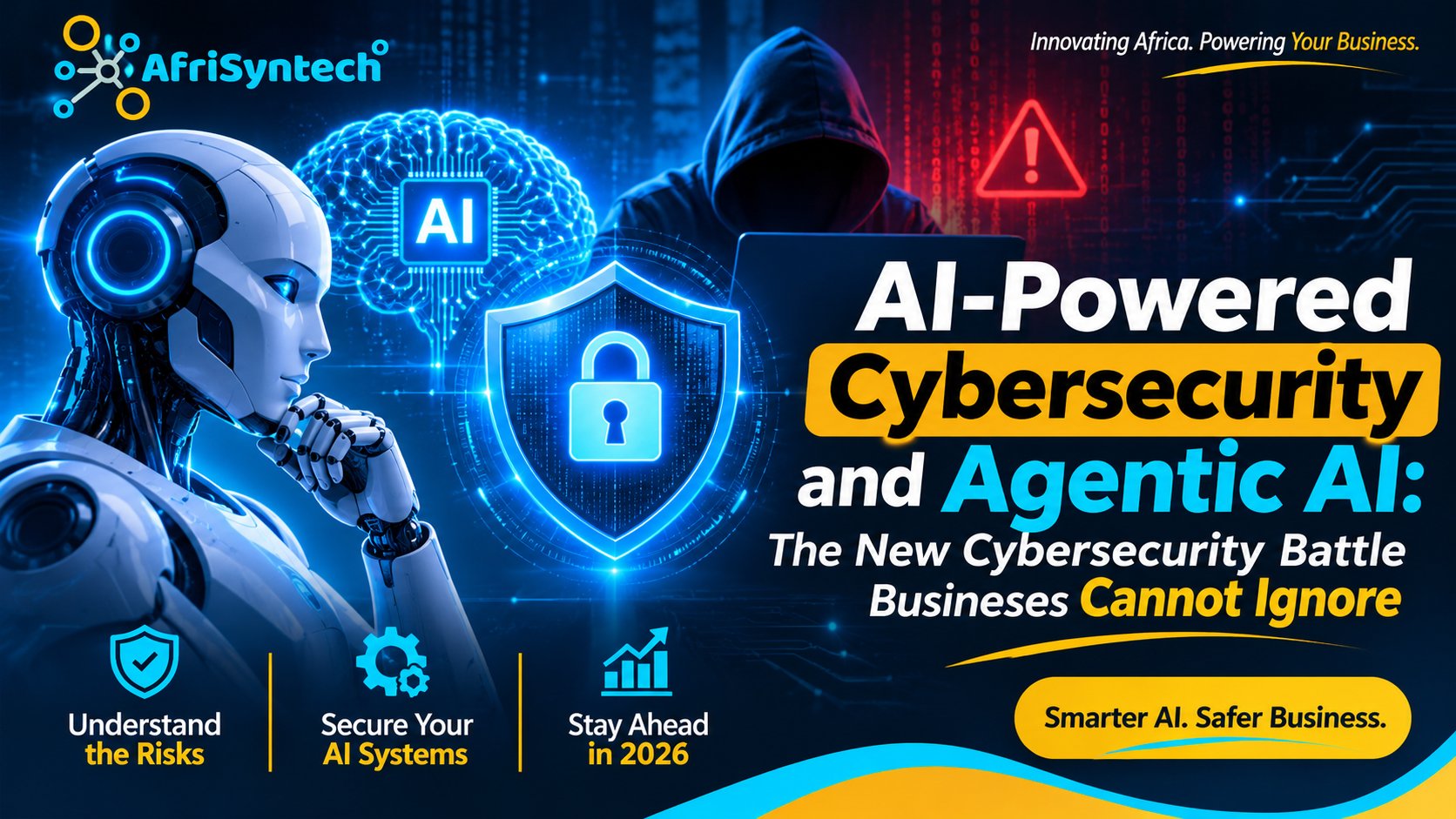
AI-Powered Cybersecurity and Agentic AI: The New Cybersecurity Battle Businesses Cannot Ignore
AI is no longer just helping businesses work faster. It is changing how cyberattacks are carried out—and how businesses must defend themselves.
For years, cybersecurity followed a relatively familiar pattern.
A hacker found a vulnerability.
They investigated the target.
They wrote or modified tools.
They attempted to gain access.
They moved through the network.
Security teams tried to detect and stop them.
Much of that work depended on human time and human decision-making.
That is changing.
In 2026, artificial intelligence is increasingly being used to automate parts of the attack lifecycle. At the same time, businesses are deploying agentic AI systems that can access data, call APIs, interact with software and take actions with limited human intervention.
This creates a new cybersecurity reality:
The same technology that can help a business automate its operations can also increase the speed, scale and sophistication of cyberattacks.
Recent incidents have demonstrated that this is no longer simply a theoretical concern. Reuters reported in October that autonomous AI agents were used in a campaign targeting more than 1,200 websites, with the agents independently searching for vulnerabilities and executing parts of attacks.
And on November 3, 2026, the UK's National Cyber Security Centre warned that organizations should prepare for AI-powered attacks against critical infrastructure, emphasizing that AI can accelerate the exploitation of vulnerabilities that already exist.
For businesses, the question is no longer whether AI will affect cybersecurity.
The question is whether your business will be prepared when it does.
---
What Is AI-Powered Cybersecurity?
AI-powered cybersecurity refers to the use of artificial intelligence and machine learning to identify, analyze, prevent and respond to cyber threats.
Traditional security systems often rely heavily on predefined rules and known threat signatures.
AI can take a different approach.
It can analyze large volumes of activity, identify unusual behavior, detect patterns and help security teams prioritize threats.
For example, an AI-powered security system could notice that:
- An employee normally logs in from Nairobi during business hours.
- Their account suddenly accesses the system from another country.
- Hundreds of files are downloaded within minutes.
- Several privileged systems are accessed.
- A new API token is generated.
- The account then attempts to access financial information.
Individually, some of these activities might not trigger a traditional rule.
Together, they could indicate a compromised account.
AI can help connect those signals much faster.
But there is another side to the story.
Attackers are using AI too.
---
The Cybersecurity Battlefield Is Becoming AI-Powered
Cybercriminals have historically looked for ways to automate repetitive work.
AI gives them a much more powerful automation layer.
Attackers can potentially use AI to assist with:
1. Reconnaissance
AI systems can help analyze publicly available information about organizations, technologies, employees and infrastructure.
Instead of manually researching hundreds of potential targets, attackers can automate parts of the process.
2. Phishing and Social Engineering
AI can generate convincing messages tailored to specific individuals.
Instead of sending generic:
"Your account has been compromised."
an attacker can potentially create a message that understands the recipient's role, company and communication style.
This makes identifying phishing attempts increasingly difficult.
3. Vulnerability Discovery
AI agents can be used to search systems for weaknesses and investigate possible attack paths.
This is particularly concerning because autonomous agents can work continuously.
A human attacker may stop after several hours.
An automated system does not necessarily have the same limitation.
4. Credential Theft
AI can assist with creating and optimizing campaigns designed to steal passwords, session tokens and other credentials.
Google's threat intelligence research has also documented attackers moving toward workflows in which AI handles multiple connected tasks rather than simply generating text or code.
5. Malware and Attack Tool Development
AI can assist attackers with programming, troubleshooting and adapting tools.
This does not mean AI magically creates unstoppable malware.
The bigger issue is speed.
AI can reduce the amount of manual work required to develop and modify attack tooling.
6. Scaling Attacks
This may be the biggest change of all.
One attacker can potentially use AI agents to target many organizations simultaneously.
That changes the economics of cybercrime.
---
What Makes Agentic AI Different?
To understand the next stage of cybersecurity, businesses need to understand the difference between traditional AI and agentic AI.
A normal AI chatbot might answer:
"How many products did we sell last month?"
An AI agent could potentially:
1. Access the company's database.
2. Query sales records.
3. Analyze the information.
4. Generate a report.
5. Send the report to management.
6. Update another system.
7. Schedule a follow-up task.
The important difference is action.
Agentic AI is designed to perform tasks rather than simply generate responses.
That makes it extremely powerful for business automation.
It also introduces a new category of cybersecurity risk.
---
Your AI Agent Is Becoming Part of Your Attack Surface
Consider a company that deploys an AI agent to help its finance department.
The agent can:
- Read invoices.
- Access accounting records.
- Query the database.
- Communicate with suppliers.
- Generate reports.
- Trigger payment workflows.
Now imagine the agent is compromised, manipulated or given malicious instructions.
The attacker may not need to break directly into the accounting system.
They may instead manipulate the agent.
This is one reason agentic AI security is becoming such an important topic.
Gartner identifies "shadow AI agents" as a growing cybersecurity challenge because employees can create or use agents outside formal organizational oversight. It recommends organizations discover, inventory and assess agents according to their autonomy and access to sensitive information.
This creates a new security question:
Who authorized the AI agent, what can it access, and what is it allowed to do?
---
The Five Biggest Agentic AI Security Risks
1. Excessive Permissions
One of the biggest mistakes businesses can make is giving an AI agent more access than it actually needs.
If an agent only needs to read customer orders, why should it have access to payroll?
If it only needs to generate reports, why should it be able to delete database records?
The principle should be simple:
Give every AI agent the minimum permissions required to perform its job.
This is the same principle used in traditional cybersecurity: least privilege.
---
2. Prompt Injection
AI agents can be manipulated through malicious instructions embedded in the information they process.
For example, an agent could be instructed to summarize a document.
Hidden inside that document could be malicious content attempting to influence the agent's behavior.
If the agent has access to internal systems, the consequences could be much more serious.
Gartner has specifically highlighted "agentic automation hijacking," where attackers manipulate agent behavior through techniques such as prompt injection or compromised tools.
---
3. Data Leakage
AI agents often need access to business information.
That could include:
- Customer records
- Financial data
- Internal documents
- Employee information
- Source code
- Contracts
- Business strategies
- API credentials
If those systems are not properly secured, an AI agent can become an unintended pathway for sensitive information to leave the organization.
---
4. Rogue or Shadow AI Agents
An employee may create an AI automation because they want to save time.
They might connect an AI service to:
- Google Drive
- Email
- CRM
- Accounting software
- Internal databases
- Customer systems
The automation may work perfectly.
But the security team may not even know it exists.
That is the problem with shadow AI.
Organizations cannot secure systems they cannot see.
---
5. Autonomous Actions
The more autonomy an AI agent receives, the greater the potential impact of an error or compromise.
An AI that only recommends an action is different from an AI that executes it.
For example:
Low risk:
"I recommend blocking this suspicious IP address."
Higher risk:
"I have blocked the IP address."
Potentially much higher risk:
"I detected suspicious activity and automatically disabled 200 customer accounts."
Automation can be powerful.
But important actions should have appropriate controls.
---
AI Is Also Becoming One of the Best Defensive Tools
It would be a mistake to look at AI only as a threat.
The same technology can dramatically improve cybersecurity.
AI can help organizations:
Detect unusual behavior
AI can analyze activity across users, devices, applications and networks to identify anomalies.
Prioritize security alerts
Security teams can receive thousands of alerts.
AI can help determine which events deserve immediate attention.
Investigate incidents
Instead of manually reviewing logs for hours, AI can help correlate events and build a timeline.
Respond faster
AI-powered systems can automate certain defensive actions when predefined conditions are met.
Find vulnerabilities
AI can help developers and security teams identify weaknesses in applications and code.
Monitor AI agents
Organizations can use AI security tooling to monitor agent behavior, permissions and activity.
The goal is not to replace cybersecurity professionals.
The goal is to help them operate at the speed required by modern threats.
---
The Real Battle Is Becoming Machine Speed vs Human Speed
This may be the most important lesson for business leaders.
A human security analyst might need hours to investigate an incident.
An automated attacker can operate continuously.
That creates an uncomfortable imbalance.
If an attacker can discover vulnerabilities, test attack paths and adapt automatically while defenders are still reviewing their first alert, traditional security processes may struggle.
Recent research from CrowdStrike found threat actors increasingly using AI agents that can make decisions and execute commands during campaigns.
At the same time, organizations are beginning to use agentic AI defensively to investigate and respond to threats faster.
This means the future of cybersecurity may not simply be:
Humans vs hackers.
It may increasingly become:
AI-assisted defenders vs AI-assisted attackers—with humans controlling the most important decisions.
---
What Should African Businesses Do?
This discussion can sound like something that only concerns large multinational companies.
It doesn't.
A small business using:
- WhatsApp
- Email
- Mobile money
- Cloud applications
- Online banking
- E-commerce
- Accounting software
- CRM systems
- AI tools
- Custom software
already has a cybersecurity responsibility.
And as more African businesses adopt AI automation, chatbots and AI agents, the attack surface will continue to evolve.
The solution is not to avoid AI.
The solution is to adopt AI responsibly.
---
10 Practical Steps Businesses Can Take
1. Know Where AI Is Being Used
Create an inventory of your organization's AI tools and agents.
Ask:
- What AI systems are we using?
- Who owns them?
- What data do they access?
- What systems can they connect to?
- What actions can they perform?
---
2. Apply Least-Privilege Access
Never give an AI agent unrestricted access simply because it is convenient.
Give it only the permissions it needs.
---
3. Protect API Credentials
AI agents frequently interact with APIs.
API keys, tokens and credentials should never be hard-coded into applications or exposed unnecessarily.
Use secure secret management and rotate credentials when appropriate.
---
4. Keep Humans in the Loop
For high-impact actions, require human approval.
For example:
AI recommends → Human approves → System executes.
This can be particularly important for:
- Payments
- Account deletion
- Data exports
- Privilege changes
- Customer communication
- Production deployments
---
5. Monitor Agent Activity
Treat an AI agent like a digital employee.
Know:
- What it did
- When it acted
- What data it accessed
- Which APIs it called
- What decisions it made
- Which systems it interacted with
If something goes wrong, you need an audit trail.
---
6. Secure the Data Feeding Your AI
Do not assume that because an AI model is secure, the information it receives is automatically trustworthy.
Validate data sources.
Control access.
Separate sensitive information.
Monitor unusual data flows.
---
7. Test for Prompt Injection
If your AI agent reads emails, documents, websites or customer messages, test whether malicious instructions can manipulate its behavior.
AI security testing should become part of the development process.
---
8. Secure Your Software Supply Chain
AI applications often depend on:
- Open-source packages
- APIs
- Plugins
- Frameworks
- Cloud services
- External models
A weakness in one dependency can become a weakness in the entire system.
---
9. Have a Recovery Plan
No security system is perfect.
Businesses should know what happens when something goes wrong.
Have:
- Backups
- Incident response procedures
- Access revocation procedures
- Recovery plans
- Contact lists
- Logging
- Business continuity plans
---
10. Make Security Part of AI Development
Security should not be something added after the AI system has been built.
It should be considered during:
Planning → Development → Testing → Deployment → Monitoring → Maintenance
This is especially important when building custom AI agents.
---
A Simple Framework for Secure Agentic AI
Before deploying an AI agent, ask these six questions:
1. What can it see?
Identify all data sources.
2. What can it access?
Identify applications, databases and APIs.
3. What can it change?
Identify whether it can create, modify or delete information.
4. What can it execute?
Identify actions it can perform automatically.
5. What happens if it is compromised?
Assume the agent may eventually be manipulated.
6. Can a human stop it?
Every high-impact autonomous system should have a clear control or shutdown mechanism.
If you cannot answer these questions, the agent may not be ready for production.
---
The Future of Business AI Will Be More Autonomous—and More Security-Conscious
Agentic AI is not going away.
Businesses are moving beyond simple chatbots toward systems that can reason through tasks, use tools, interact with software and complete workflows.
That creates enormous opportunities.
Imagine an AI agent that can:
- Receive a customer request.
- Check inventory.
- Generate an invoice.
- Send a WhatsApp message.
- Update the CRM.
- Schedule delivery.
- Notify the finance team.
That could save a business hundreds of hours.
But every additional capability also creates another security consideration.
The objective should therefore not be:
"How much can we automate?"
It should be:
"How much can we automate safely?"
That distinction will separate mature AI adoption from reckless AI adoption.
---
The Biggest Cybersecurity Mistake Businesses Can Make in 2026
The biggest mistake is assuming that AI security is only a problem for large technology companies.
It isn't.
A small business with one employee using an AI tool connected to company data can create a security risk.
A developer who builds an AI agent with access to a production database can create a security risk.
A company that connects an AI chatbot to internal documents can create a security risk.
A business that gives an AI system permission to send emails, make transactions or modify records can create a security risk.
AI security starts the moment AI touches your business data or systems.
---
Final Thoughts
The cybersecurity industry has entered a new chapter.
Artificial intelligence is helping defenders analyze threats faster, automate security operations and identify suspicious behavior.
At the same time, attackers are using AI to automate reconnaissance, discover vulnerabilities, generate attack tooling and scale campaigns.
And agentic AI is pushing the situation even further by giving software the ability to make decisions and take actions.
That creates both an opportunity and a warning.
Businesses should not respond by abandoning AI.
They should respond by becoming **better at secure AI adoption**.
The organizations that succeed will not necessarily be those that use the most AI.
They will be the ones that understand what their AI can access, what it can do, how it can be controlled and what happens when something goes wrong.
The future of AI belongs to autonomous systems.
The future of cybersecurity belongs to organizations that know how to control them.
AI should make your business more capable—not more vulnerable.
---
Frequently Asked Questions
Is AI making cyberattacks more dangerous?
Yes. AI can help attackers automate and accelerate activities that previously required significant human effort. Recent campaigns have demonstrated AI agents being used for reconnaissance, vulnerability discovery and other parts of cyber operations.
What is agentic AI?
Agentic AI refers to AI systems designed to perform tasks with a degree of autonomy. Unlike a basic chatbot that primarily generates responses, an AI agent can potentially use tools, access systems, make decisions and execute actions.
Can AI agents be hacked?
Yes. AI agents can introduce risks including prompt injection, compromised tools, excessive permissions, data leakage and unauthorized actions.
Should businesses avoid AI agents because of cybersecurity risks?
No. Businesses should focus on secure implementation. AI agents can provide significant productivity benefits when their permissions, data access, monitoring and actions are properly controlled.
How can a small business secure AI?
Start with the basics: inventory your AI tools, restrict permissions, protect credentials, secure sensitive data, monitor activity, maintain backups and require human approval for high-impact actions.
Is AI-powered cybersecurity only for large companies?
No. Small and medium-sized businesses can benefit from AI-assisted monitoring and security automation, particularly as they increasingly rely on cloud systems, online payments, e-commerce, APIs and AI-powered applications.
---
Sources & References
- Reuters — AI agents used in campaign targeting more than 1,200 websites
- Reuters — UK NCSC warning on AI-powered attacks and critical infrastructure
- Gartner — The AI Agents You Can't See Can Still Create Risk
- Gartner — Cybersecurity Threat: Agentic Automation Hijack
- CrowdStrike — New Agentic AI Campaigns
- Microsoft Security — AI-driven campaign using agentic AI
- McKinsey — Securing the Agentic Enterprise
---
Disclaimer
This article is published by Afrisyntech Solutions for informational and educational purposes only. It is based on publicly available information, security research, industry reports and news coverage available at the time of publication.
Cybersecurity threats and AI technologies are continuously evolving, and information surrounding specific incidents may change as investigations and research develop.
The cybersecurity recommendations provided in this article are general guidance and should not be considered a substitute for a professional cybersecurity assessment, legal advice or specialized security consulting.
Afrisyntech is an independent technology company and is not affiliated with or endorsed by the organizations mentioned in this article.
Organizations should assess their own technology environments, risks and regulatory obligations before implementing AI systems or cybersecurity controls.
Afrisyntech accepts no responsibility for decisions or actions taken solely on the basis of this article.
---
**About Afrisyntech**
Afrisyntech helps businesses build and integrate **custom software, AI solutions and intelligent automation** designed around real business workflows.
From AI-powered applications and chatbots to business automation, dashboards, custom systems and AI agents, our focus is helping organizations use technology to operate more efficiently while building with security and scalability in mind.
Learn more: https://afrisyntech.com