Nairobi, Kenya-headquartered · Serving Africa & Beyond
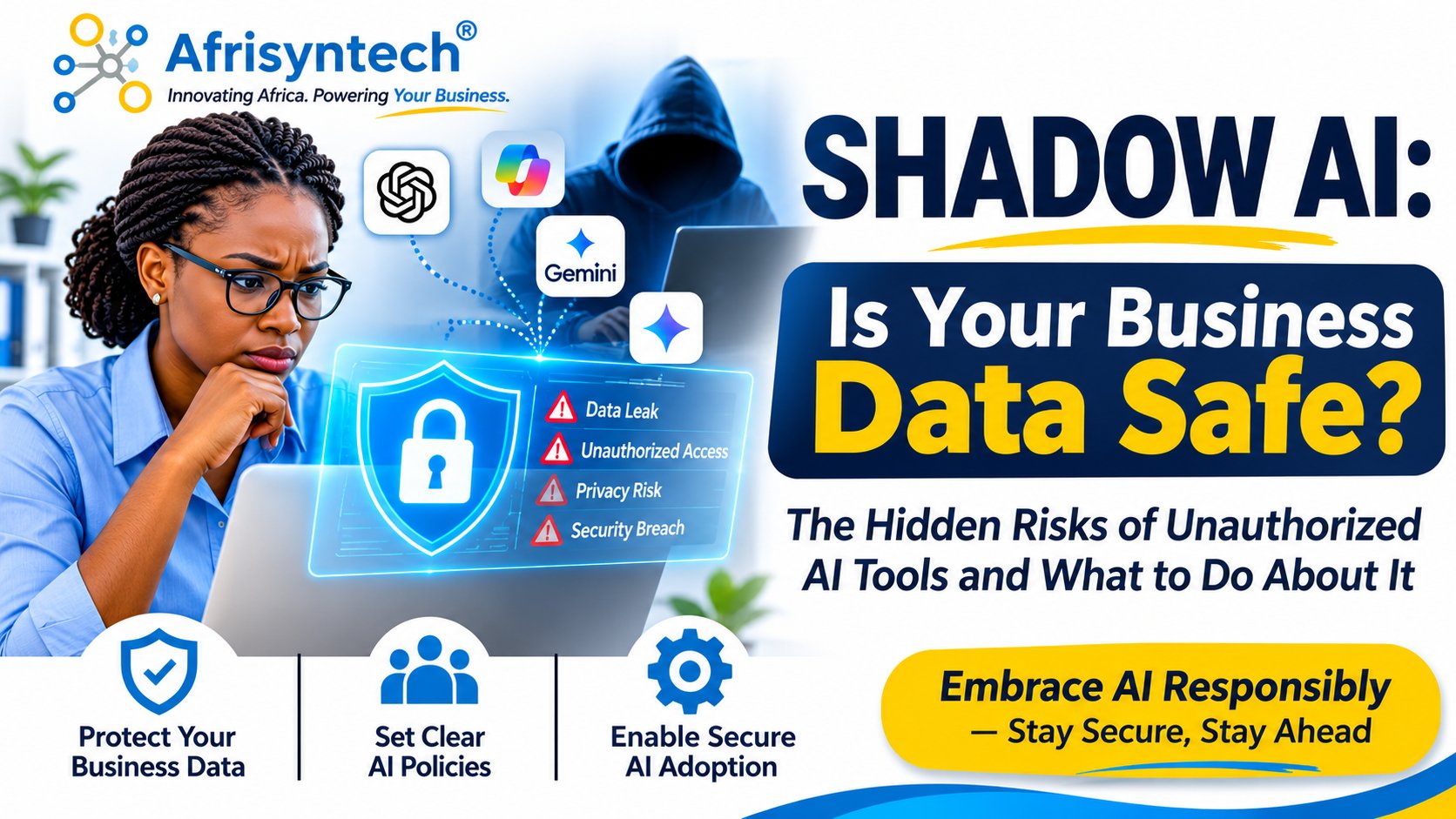
Your Employees Are Using AI at Work. Is Your Business Data Safe?
Shadow AI is quietly creating a new cybersecurity challenge for businesses. Discover how unauthorized AI tools can expose company data, create security vulnerabilities and what organizations should do about it.
Artificial intelligence is becoming part of everyday business operations.
Employees are using AI to write emails, analyze spreadsheets, summarize meetings, generate reports, write code, respond to customers and automate repetitive tasks.
For businesses, this presents an enormous opportunity. Tasks that previously took hours can now be completed in minutes. Teams can work more efficiently, improve productivity and deliver better customer experiences.
But there is a problem many organizations are overlooking.
What happens when employees start using AI tools that the business has never approved, evaluated or secured?
An employee might upload a customer database to an AI platform to generate a report. A developer might paste confidential source code into an AI coding assistant. A marketing employee might upload an internal business strategy to generate a campaign.
Their intentions may be completely innocent. They are simply trying to get work done faster.
However, the organization may have no visibility into where that information goes, how it is processed, who can access it or what happens to it afterward.
This growing challenge is known as Shadow AI.
And as artificial intelligence becomes more deeply integrated into business operations, ignoring it could expose organizations to risks they are not prepared to manage.
What Is Shadow AI?
Shadow AI refers to the use of artificial intelligence tools, applications, services or agents within an organization without appropriate approval, visibility or oversight.
It is closely related to an older cybersecurity concept called Shadow IT, where employees introduce software, cloud services or devices into their work without formal IT authorization.
The difference is that AI tools can do more than store or process information. They can analyze sensitive data, generate content, interact with business applications and, increasingly, perform actions on behalf of users.
Examples of Shadow AI include:
- Employees using personal AI accounts for confidential business work.
- Staff uploading customer records to public AI platforms.
- Developers using unapproved AI coding assistants with proprietary source code.
- Employees installing AI browser extensions without security review.
- Departments creating AI-powered automations without involving IT.
- AI agents connecting to company databases or applications without formal authorization.
- Employees using AI features embedded in third-party software without understanding how company information is processed.
Not every use of an unapproved AI tool automatically results in a security incident. However, each unmanaged use can create an exposure that the organization may not be able to identify or control.
According to Gartner's September 2026 research, 75% of surveyed organizations reported unauthorized use of AI coding assistants, while 50% reported employee access to public SaaS generative AI agent platforms.
These findings illustrate how quickly AI adoption can move beyond formal organizational oversight.
The challenge is no longer simply controlling which software employees install. It is understanding which AI systems are interacting with company information and what those systems are allowed to do.
Why Are Employees Using Unauthorized AI Tools?
Before addressing Shadow AI, businesses need to understand why it happens.
In most cases, employees are not deliberately trying to undermine company security.
They are responding to the pressure to work faster, solve problems and deliver results.
Consider a few everyday situations.
The finance employee:An employee receives a large spreadsheet containing financial transactions. Instead of manually analyzing the data, they upload it to an AI tool and ask it to identify trends.
The marketing team: A marketer uploads customer information, campaign results and internal strategy documents to an AI platform to generate marketing recommendations.
The software developer: A developer uses an AI coding assistant to debug an application, unknowingly sharing proprietary source code or configuration details.
The customer support representative: An employee copies customer complaints, phone numbers and personal information into an AI chatbot to generate responses.
The business owner: A small business owner connects an AI automation tool to email, cloud storage and customer management software without fully understanding its permissions.
In each situation, the employee is trying to improve productivity.
The problem is that the organization may not have approved the tool, assessed its data-handling practices or established controls for its use.
There are several reasons this happens:
1. **Convenience:** Public AI tools are easy to access and often have free versions.
2. **Productivity pressure:** Employees want to complete more work in less time.
3. Lack of approved alternatives: Organizations may restrict AI without providing secure alternatives.
4. Limited awareness:Employees may not understand the implications of uploading confidential information.
5. Rapid technological change:New AI tools and features appear faster than many organizations can evaluate them.
6. Decentralized adoption:Individual departments may introduce AI tools without informing management or IT teams.
This leads to an important conclusion:
Businesses cannot manage Shadow AI effectively through restrictions alone. They need visibility, practical policies and approved tools that help employees do their jobs safely.
Six Hidden Risks of Shadow AI Every Business Should Understand
Shadow AI can create several interconnected risks. Some involve data protection, while others affect cybersecurity, business continuity and organizational trust.
1. Confidential Business Data Exposure
One of the most immediate risks is employees sharing sensitive information with external AI services without understanding the applicable data-handling arrangements.
This information could include:
- Customer names and contact details.
- Financial statements.
- Employee records.
- Business contracts.
- Internal reports.
- Product designs.
- Source code.
- Business strategies.
- Commercially sensitive documents.
Once information is submitted to an external platform, the organization may have limited control over how that information is processed, retained or accessed, depending on the provider, account type, settings and contractual arrangements.
This does not mean every AI platform automatically uses customer information to train its models. Data practices differ between providers and products.
However, businesses should never assume that information submitted to an AI service is automatically protected under their own internal security policies.
The practical lesson: Employees should understand what information they are allowed to share, which AI platforms are approved and what data protections apply.
2. Customer Privacy and Data Protection Risks
Customer information is among the most valuable assets a business holds.
Imagine a Kenyan company that manages customer orders, phone numbers, delivery addresses and payment records.
An employee wants to use AI to analyze customer complaints and improve service delivery.
They export customer records and upload them to an AI platform.
The employee may have no malicious intentions, but the organization has potentially transferred personal information to a third-party service without properly assessing the privacy implications.
For businesses operating in Kenya, this deserves particular attention.
The Kenya Data Protection Act, 2019 establishes obligations relating to the processing of personal data, including lawful processing, data protection principles and the rights of data subjects.
Organizations should assess whether their AI use complies with applicable data protection requirements, including obligations relating to processors, security safeguards and international transfers where relevant.
Using AI does not remove a business's responsibility to protect personal information.
Businesses should consult the Office of the Data Protection Commissioner (ODPC)](https://www.odpc.go.ke) and qualified professionals when assessing their obligations.
3. Intellectual Property and Source Code Exposure
AI coding assistants are becoming increasingly useful for software developers.
They can help explain code, identify bugs, generate functions, write tests and accelerate development.
However, developers may unintentionally expose proprietary information when using tools that have not been approved by their organizations.
For example, a developer might submit:
- Proprietary source code.
- Database connection details.
- Internal API specifications.
- Authentication logic.
- Unreleased product designs.
- Configuration files containing sensitive information.
Depending on the tool and its settings, submitted information may be processed or retained under terms the organization has not reviewed.
This can create intellectual property, confidentiality and security concerns.
For software companies, startups and organizations building custom applications, protecting source code and development credentials should be part of their AI usage policy.
4. Unauthorized Access Through AI Integrations
The risk becomes more serious when employees move beyond simple AI chatbots and start connecting AI tools to business systems.
Modern AI applications can integrate with:
- Email platforms.
- Cloud storage.
- Customer relationship management systems.
- Accounting software.
- Internal databases.
- Project management tools.
- Business APIs.
- Communication platforms.
These integrations can make AI significantly more useful.
But every connection introduces permissions and potential access pathways that must be managed.
For example, an employee might authorize an AI assistant to access an entire cloud storage account when it only needs permission to read a particular folder.
If the integration is compromised or misused, the consequences could extend beyond the original task.
Businesses should therefore review what each AI application can access, what actions it can perform and whether those permissions can be restricted.
5. Uncontrolled AI Agents
The next stage of AI adoption involves systems that can perform tasks rather than simply generate answers.
These systems are commonly described as AI agents or agentic AI.
An AI agent might be able to read emails, retrieve information from a database, update records, call external APIs or trigger automated workflows.
Imagine a sales department creating an AI agent that can:
1. Read incoming customer enquiries.
2. Retrieve customer information.
3. Check product availability.
4. Generate quotations.
5. Update the CRM.
6. Send follow-up messages.
This could improve efficiency significantly.
However, if the agent is created without proper security controls, the business may not know what information it can access, which actions it can execute or how to stop it when something goes wrong.
Gartner identifies unmanaged AI agents as an emerging cybersecurity governance challenge, emphasizing the need to discover, inventory and assess agents according to their access and autonomy.
The more independently an AI system can act, the more important its permissions, monitoring and human oversight become.
6. Reputational and Financial Damage
A data exposure incident can affect much more than technology.
Customers expect businesses to protect their personal information. Business partners expect confidential information to remain secure. Employees expect their own information to be handled responsibly.
If an organization loses control of sensitive information through an unmanaged AI tool, the consequences may include:
- Loss of customer confidence.
- Legal and regulatory exposure.
- Financial losses.
- Operational disruption.
- Contractual disputes.
- Damage to the company's reputation.
For small and medium-sized businesses, rebuilding customer trust after a serious data incident can be particularly difficult.
AI should help a business become more competitive, not introduce risks that undermine the trust it has worked to build.
Shadow AI Is Also an African Business Problem
AI adoption is not limited to large technology companies in Europe, North America or Asia.
Businesses across Africa are increasingly exploring AI to improve customer service, automate operations, analyze information and reduce operational costs.
A small business might use AI to generate quotations, respond to WhatsApp enquiries, prepare reports or manage customer communications.
A growing company might introduce AI-powered CRM systems, automated workflows or internal knowledge assistants.
A software startup might use AI coding tools to accelerate application development.
These are valuable use cases.
However, businesses should not assume that being small makes them immune to AI-related security risks.
Consider a few practical examples.
Retail businesses: Customer purchase records, contact details and transaction information could be exposed through poorly managed AI integrations.
Financial and professional services: Client documents, financial records and confidential communications require careful handling when AI tools are introduced.
Healthcare providers: Patient information requires particularly strong privacy and security controls.
E-commerce businesses: AI tools connected to orders, customer accounts and payment-related workflows need appropriate access restrictions.
Startups and software companies: Proprietary source code, API credentials and product information should be protected when developers use AI coding assistants.
The EY Africa Cybersecurity Threat Outlook 2026 identifies Shadow IT and Shadow AI as growing sources of organizational risk in African environments. It highlights uncontrolled data sharing, automated decision-making and limited visibility as important concerns.
This reinforces an important message:
African businesses should treat AI governance as part of their digital transformation strategy, not something to consider after an incident occurs.
How Can Businesses Adopt AI Without Exposing Their Data?
The answer is not to ban artificial intelligence.
AI offers real opportunities to improve productivity, customer experiences and business operations.
The goal should be to create an environment where employees can use AI productively while the organization maintains appropriate control over its information and systems.
Here are ten practical steps businesses can take.
1. Identify All AI Tools Being Used
Start by understanding the current situation.
Ask employees and departments which AI tools they use for work.
Include:
- Public AI chatbots.
- AI writing assistants.
- Coding assistants.
- AI-powered browser extensions.
- Meeting transcription tools.
- AI features embedded in existing software.
- AI agents and automation platforms.
Do not limit the exercise to tools purchased by the IT department.
The objective is to identify both approved and unapproved AI use.
2. Create an Approved AI Tools List
Businesses should establish a list of AI applications employees are permitted to use.
Before approving a platform, evaluate:
- Its privacy policy.
- Data retention practices.
- Security controls.
- Data processing terms.
- Access management capabilities.
- Integration permissions.
- Available administrative controls.
- Suitability for the intended business use.
Different tools offer different levels of protection. A platform suitable for generating public marketing ideas may not be suitable for processing confidential customer records.
3. Classify Business Information
Not all business information carries the same level of risk.
Create clear categories, such as:
| Data classification | Examples | AI usage guidance |
|---|---|---|
| Public | Published articles, public product descriptions | Generally suitable for approved AI tools |
| Internal | Internal procedures, non-public operational notes | Use only with approved tools and controls |
| Confidential | Contracts, financial records, business strategies | Require explicit authorization and appropriate safeguards |
| Restricted | Passwords, API keys, sensitive personal records | Do not enter into public AI tools; use tightly controlled systems where processing is authorized |
This gives employees practical guidance rather than expecting them to make complex security decisions every time they use AI.
4. Apply Least-Privilege Access
AI applications should only receive the permissions necessary to perform their assigned tasks.
If an AI agent needs to read customer enquiries, it should not automatically receive permission to access payroll records.
If an assistant needs to generate reports, it should not have unrestricted database write or delete permissions.
Apply the principle of least privilege to AI tools, integrations, APIs and service accounts.
5. Protect API Keys and Credentials
AI systems often connect to other applications through APIs.
These integrations may require credentials such as API keys, access tokens or service-account permissions.
Never expose these credentials in prompts, public repositories, browser-accessible code or unprotected configuration files.
Use secure secret management, appropriate access controls and credential rotation.
6. Establish an AI Usage Policy
A business should clearly explain:
- Which AI tools are approved.
- What information employees may submit.
- What information must never be shared.
- How AI-generated content should be reviewed.
- Who can approve new AI integrations.
- What rules apply to AI agents.
- How employees should report suspected data exposure.
The policy should be practical, understandable and relevant to actual business workflows.
A policy that employees cannot understand or follow will not provide meaningful protection.
7. Require Human Approval for High-Impact Actions
AI can recommend actions, prepare information and automate routine tasks.
However, businesses should carefully control activities that could cause significant financial, operational or legal consequences.
For example:
- Approving payments.
- Issuing refunds.
- Deleting customer records.
- Changing account permissions.
- Sending sensitive customer communications.
- Modifying production systems.
A useful approach is:
AI recommends → Human reviews → Authorized system executes.
As confidence in an AI workflow grows, businesses may introduce carefully defined automation for lower-risk tasks while retaining stronger approval requirements for high-impact activities.
8. Monitor AI Activity
Organizations should maintain visibility into how their AI systems are being used.
Where technically possible, record:
- Which AI applications are connected.
- Which users and agents access them.
- What data sources they can reach.
- Which APIs they call.
- What actions they execute.
- When significant changes occur.
Monitoring and audit logs make it easier to investigate unusual behavior and establish accountability.
9. Train Employees
Employees are an important part of AI security.
They should understand why certain information must not be entered into unapproved AI systems.
Training should cover:
- Safe use of AI tools.
- Customer data protection.
- Confidential business information.
- AI-generated misinformation.
- Prompt injection awareness.
- Phishing and impersonation.
- Responsible use of AI agents.
The objective is not to make employees afraid of AI.
It is to help them use it responsibly.
10. Review and Update Security Controls Regularly
AI technology changes quickly.
A tool that initially only generated text may later introduce file access, browser automation or integrations with other business applications.
Organizations should regularly review their AI inventory, permissions, policies and vendor arrangements.
AI security should be an ongoing responsibility rather than a one-time implementation exercise.
A Practical AI Security Checklist for Business Owners
Before introducing an AI tool or agent into your organization, consider the following questions.
- [ ] Do we know which AI tools our employees are using?
- [ ] Has this tool been reviewed and approved?
- [ ] Do we understand how it handles business information?
- [ ] Have we identified the data it will access?
- [ ] Are sensitive records adequately protected?
- [ ] Does the tool have only the permissions it needs?
- [ ] Are API credentials and access tokens protected?
- [ ] Can we monitor its activities?
- [ ] Are employees trained on acceptable AI usage?
- [ ] Is there a process for responding to AI-related security incidents?
If you cannot confidently answer these questions, your organization should review the proposed AI implementation before expanding its use.
Should Businesses Ban Shadow AI?
A complete ban might appear to be the easiest solution.
However, it does not necessarily address the underlying problem.
Employees may continue using AI tools through personal accounts, personal devices or browser extensions. They may simply become less transparent about their activities.
At the same time, preventing employees from using useful AI tools can reduce productivity and discourage innovation.
A better approach is controlled AI adoption.
Businesses should identify the tools employees need, evaluate their security, provide approved alternatives and establish clear rules for responsible usage.
Management should also create a process through which employees can request approval for new AI tools.
This approach recognizes that AI adoption is happening and focuses on making it safer.
The objective is not to stop employees from using technology.
It is to ensure that the technology they use does not compromise the organization.
The Future: From AI Tools to AI-Managed Business Operations
The Shadow AI challenge will become even more important as businesses move from simple AI assistants toward autonomous AI agents.
Today, an employee might use AI to summarize a document.
Tomorrow, an AI agent might retrieve that document, compare it against internal records, generate a recommendation, update a business application and notify the relevant department.
These capabilities could transform how organizations operate.
But they also introduce new questions:
- Who is responsible for an AI agent's actions?
- What information can it access?
- Can it execute transactions?
- How are its decisions monitored?
- What happens if it receives malicious instructions?
- Can its permissions be revoked immediately?
- Can the organization reconstruct what happened during an incident?
These questions should be considered during the design and development of AI systems.
Security, access management, data protection, monitoring and human oversight should not be added as afterthoughts.
They should be part of the architecture from the beginning.
For businesses building custom AI applications, this means considering security throughout the entire development lifecycle: planning, design, development, testing, deployment and ongoing maintenance.
## Final Thoughts: AI Adoption Without Security Is a Business Risk
Artificial intelligence is creating opportunities that businesses should not ignore.
It can reduce repetitive work, improve decision-making, support customer service and help organizations build more efficient operations.
But the growing use of unauthorized AI tools demonstrates that innovation without proper oversight can introduce risks that are difficult to manage.
Shadow AI is not necessarily the result of employees acting irresponsibly. Often, it is a sign that employees want better tools and organizations have not yet established a clear approach to providing them.
Businesses need to respond with visibility, education, appropriate technology and practical governance.
The organizations that benefit most from AI will not simply be those that adopt the greatest number of tools.
They will be those that understand how to integrate AI into their operations while protecting their data, systems, customers and reputation.
**The goal should not be to choose between productivity and security. It should be to build a business where both can exist together.**
AI should make your business more capable, more efficient and more competitive.
**It should never require you to lose control of your business data.**
---
# Frequently Asked Questions
### What is Shadow AI in business?
Shadow AI refers to employees or departments using artificial intelligence tools, services or agents without appropriate organizational approval, visibility or security oversight.
### Why is Shadow AI dangerous?
It can expose confidential business information, customer records, intellectual property and system credentials. It can also introduce unmanaged integrations and automated actions that the organization cannot properly monitor or control.
### Is using ChatGPT at work considered Shadow AI?
Not necessarily. If an organization has approved the relevant ChatGPT service, established usage policies and implemented suitable data protection controls, its use may be authorized. Using an unapproved account or sharing restricted information without permission may create Shadow AI risks.
### Can AI tools access company data?
Yes. Depending on the product, configuration and permissions granted, AI tools can process uploaded documents, connected cloud files, emails, databases and information retrieved through APIs or other integrations.
### How can small businesses prevent Shadow AI?
Small businesses should identify the AI tools employees use, approve appropriate platforms, establish clear data-sharing rules, restrict access, train employees and monitor important integrations.
### Should businesses prohibit employees from using public AI tools?
Not necessarily. Businesses should assess the risks of individual tools and use cases. Some public AI services may be appropriate for certain tasks, while confidential or restricted information may require approved enterprise services or controlled internal systems.
### What is the difference between Shadow IT and Shadow AI?
Shadow IT refers to unauthorized software, hardware and technology services used within an organization. Shadow AI is a related category involving unauthorized AI tools and agents, which may introduce additional risks because they can process information, generate outputs and execute actions.
### What is AI governance?
AI governance refers to the policies, responsibilities, procedures and technical controls an organization uses to manage how artificial intelligence is selected, developed, deployed and monitored.
---
# Sources & References
The following sources informed this article. Statistics and findings should be interpreted in the context of each report's research methodology and surveyed population.
1. **Gartner (30 September 2026)** – [The AI Agents You Can't See Can Still Create Risk](https://www.gartner.com/en/articles/agentic-ai-oversight). Research on unauthorized AI tools, Shadow AI agents and cybersecurity oversight.
2. **Verizon (2026)** – [2026 Data Breach Investigations Report: Executive Summary](https://www98.verizon.com/business/resources/executivebriefs/dbir-2026-executive-summary.pdf). Findings on unauthorized generative AI usage and sensitive information submitted to external AI services.
3. **EY (2026)** – [Africa Cybersecurity Threat Outlook 2026](https://www.ey.com/content/dam/ey-unified-site/ey-com/en-za/insights/risk/documents/ey-africa-cybersecurity-threat-outlook-2026.pdf). Analysis of Shadow IT and Shadow AI risks in African organizations.
4. **TechTarget (8 October 2026)** – [Why Data Governance Struggles to Audit Shadow AI](https://www.techtarget.com/data-technologies/feature/Why-data-governance-struggles-to-audit-shadow-AI). Analysis of data governance challenges associated with unauthorized AI use.
5. **Proofpoint (2025)** – [The State of AI Security](https://www.proofpoint.com/sites/default/files/threat-reports/pfpt-us-tr-the-state-of-ai-security-2025.pdf). Research on Shadow AI, organizational readiness and AI-related security concerns.
6. **Office of the Data Protection Commissioner, Kenya** – [ODPC Official Website](https://www.odpc.go.ke/). Information on Kenya's data protection framework.
7. **Kenya Law** – [Data Protection Act, 2019](https://new.kenyalaw.org/akn/ke/act/2019/24/eng@2019-11-25). Kenya's legal framework for the processing and protection of personal data.
---
# Disclaimer
This article is published by **Afrisyntech** for informational and educational purposes only. It is based on publicly available information, research reports, industry publications and applicable public regulatory resources available at the time of publication.
The cybersecurity and AI landscape continues to evolve. Statistics and research findings cited in this article reflect the methodologies, dates and populations covered by their respective sources.
The recommendations provided are general guidance and should not be considered a substitute for a professional cybersecurity assessment, legal advice or specialized data protection consultancy.
Organizations should independently assess their technology environments, data processing activities, contractual obligations and applicable regulatory requirements before adopting AI systems.
Afrisyntech is an independent technology company and is not affiliated with or endorsed by the organizations referenced in this article.
**Afrisyntech accepts no responsibility for decisions or actions taken solely on the basis of this article.**
---
## About Afrisyntech
**Afrisyntech** helps businesses build and integrate custom software, AI solutions and intelligent automation designed around real business needs.
Our work focuses on helping organizations use technology to improve productivity, streamline operations and build more effective digital systems.
From AI-powered applications and chatbots to business automation, dashboards, custom software and AI agents, we believe technology should be built with security, reliability and scalability in mind.
**Explore our solutions:** [https://afrisyntech.com](https://afrisyntech.com)